The Numbers Behind Flat Roof Leaks in Camby
Flat roofs in Camby fail on a predictable curve. EPDM membranes installed in the 1990s and early 2000s are now 20 to 30 years old, and the adhesive at lap seams degrades at roughly 3% to 5% per year after year 15. TPO installed between 2005 and 2012 had a known plasticizer issue on early formulations, with field studies showing 25% to 35% premature seam failure by year 10. Modified bitumen, our most common repair call on older buildings, typically shows granule loss at 50% surface coverage by year 12 and full membrane cracking by year 18.
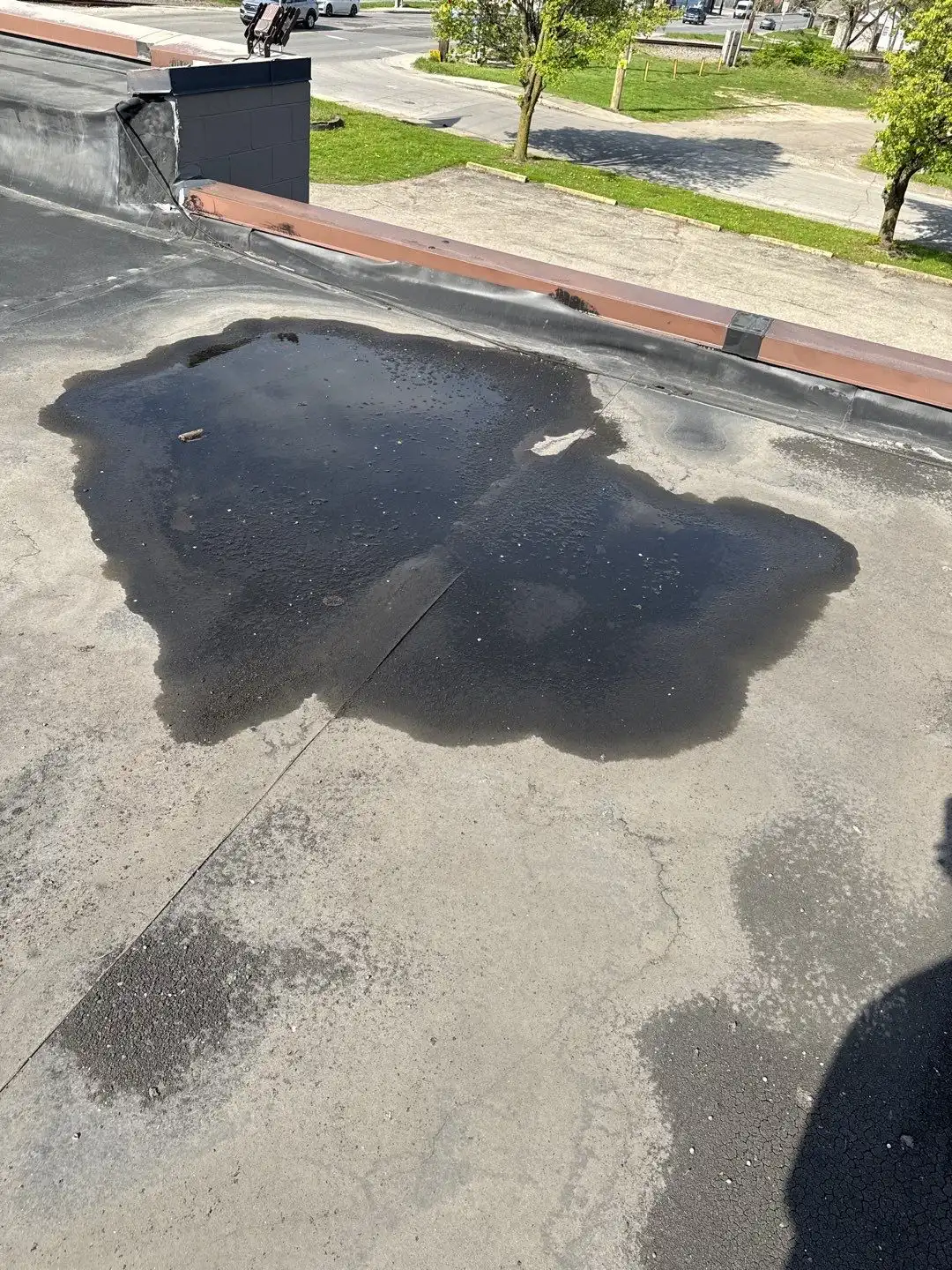
Ponding water accelerates all of this. The National Roofing Contractors Association defines ponding as standing water present 48 hours after rainfall, and roofs with chronic ponding fail 3 to 5 years sooner than properly draining roofs. In Camby, where we see 40 to 45 inches of annual precipitation spread across freeze thaw cycles, even a quarter inch low spot will trap 1.5 gallons per square foot and add roughly 12 pounds of dead load. Multiply that across a 5,000 square foot bay and you have 60,000 pounds of water sitting on insulation that was never engineered for it.
Freeze thaw cycling compounds the damage in ways building owners rarely see from the ground. Camby averages 60 to 75 freeze thaw events per winter, and each cycle expands trapped moisture by roughly 9% in volume. That expansion pries open hairline seam separations at a rate of 0.5 to 1.5 millimeters per season, which is why a roof that looked fine in October starts dripping in March. Wind uplift adds another stressor. Sustained 35 to 50 mph gusts, common during spring storm fronts, can lift unadhered insulation boards and stretch field seams that were already past their design tolerance.
Detection Methods and Their Hit Rates
Visual inspection alone catches about 60% of active flat roof leaks, which sounds reasonable until you account for the 40% that hide under intact looking membrane. The water enters at one point and travels 10 to 40 feet along the deck before showing up inside, which is why a stain under the conference room rarely sits below the actual breach. We layer three methods to push detection accuracy above 90%.
Infrared thermal scanning, run in the evening after a warm day, reads the temperature differential between dry and saturated insulation. Wet insulation holds heat 4 to 8 degrees longer than dry, and a calibrated scan maps the wet zones with 85% to 95% accuracy on single ply roofs. For deeper diagnostics on interior pathways, our moisture mapping with thermal imaging walkthrough explains how the same technology traces water inside ceilings and walls. Electronic leak detection, using low voltage current across a wetted membrane, pinpoints breaches within a 6 inch radius and runs $0.08 to $0.15 per square foot on accessible roofs. Core sampling, the most invasive method, confirms saturation depth and is reserved for pre replacement decisions where the question is whether to overlay or tear off.
The order of operations matters as much as the tools themselves. Camby Commercial Roofing starts with a documented visual sweep that catalogs every penetration, drain, scupper, and termination bar, because roughly 70% of flat roof leaks originate at these transition points rather than in the field of the membrane. Curb mounted HVAC units alone account for 25% to 30% of service calls, and 90 degree inside corners at parapet walls account for another 15% to 20%. By logging these high probability zones first, we shorten the thermal scan window and avoid spending overtime hours mapping a 30,000 square foot field when the breach is sitting six inches off a condenser curb.
Repair Costs by Failure Type
The price spread on flat roof repair is wider than most building owners expect, and the variable is almost always how long the leak ran before discovery.
A useful rule of thumb: every 30 days of undetected leakage roughly doubles the repair scope. A pinhole at a TPO seam caught in week one is a $450 reweld. The same pinhole at month six has saturated 80 to 200 square feet of polyiso insulation, dropped R-value from 20 to under 8 in that zone, and now requires deck inspection plus board replacement, pushing the same job into the $3,500 to $6,000 range. That progression is why Camby Commercial Roofing treats stain reports as time sensitive even when the drip has stopped.
Timeline From Discovery to Dry-In
When a Camby business owner calls about an active drip, the timeline matters more than the price tag. Phone triage takes 5 to 10 minutes, where we identify whether the leak is gushing, slow, or intermittent, and whether ceiling material is sagging or just stained. Active leaks get scheduled for tarping and emergency dry in ahead of diagnostic work. A 200 to 800 square foot tarp install takes 2 to 4 hours and buys 30 to 90 days of weather protection while the permanent repair gets scoped.
Detection and scoping run 1 to 3 hours on most buildings under 20,000 square feet. Permanent repairs on a single seam or boot wrap up in a half day. Larger scopes involving insulation removal, deck drying, and membrane re laying run 2 to 5 days depending on square footage and weather windows. Deck drying alone, when wet polyiso is pulled and the underlying metal or wood deck is exposed, typically needs 24 to 72 hours of forced air at 15% to 25% relative humidity before new insulation can be re laid. Skipping that step traps moisture under the new membrane and seeds the next failure within 18 to 36 months. If interior damage is already in play, our attic water damage from roof leaks guide walks through what gets dried, what gets cut out, and what your insurance carrier typically pays for.
When Repair Stops Penciling Out
The break even point on flat roof repair versus replacement sits at roughly 25% of replacement cost in any single repair cycle, or three significant repairs within 24 months. Below that, targeted repair extends useful life 5 to 10 years and runs $1.50 to $4 per square foot. Above it, you are paying repair pricing while still owning a roof that will need full replacement within 3 years. Our roof leak origin detection breakdown explains how we separate diagnostic findings from repair recommendations so you see the data before you spend.
Insurance posture also shifts at the break even line. Carriers in Camby increasingly cap coverage on roofs over 20 years old, and a documented history of three or more leak claims inside two years can trigger non renewal at the next policy cycle. Building owners who track repair spend against a rolling replacement cost benchmark tend to make the transition 12 to 18 months earlier than owners who react claim by claim, and that early window typically saves 10% to 15% on the replacement bid because the work can be scheduled in shoulder season rather than at peak summer pricing.